

Democracy Notes 2025 Trends!
Today's the day!

(If you’re looking for your usual weekly edition of Democracy Notes, here’s yesterday’s!)
Greetings!!
Today’s the day! The full release of Democracy Notes 2025 Trends!
Below, you’ll find lil previews of the 10 trends. For lots more detail, check out the full report!
And!!! Our launch event is in two hours at 1pm ET. Come hear more about the trends and discuss them!
We’ll be joined by Shannon Green, President and CEO of Philanthropy for Active Civic Engagement, and Mike Berkowitz, Executive Director of Democracy Funders Network.
Mike and Shannon will share a bit about what their organizations are doing to build the U.S. democracy ecosystem.
A big thank you to Democracy Funders Network and Philanthropy for Active Civic Engagement for sponsoring Democracy Notes 2025 Trends!
And a HUGE thank you to my co-authors: Andrew Doty, Samantha Owens, and Massarah Mikati.
Without further ado…
Democracy Notes 2025 Trends!
The 2024 election sent a jolt through the democracy ecosystem. For many practitioners and funders, the results — combined with the speed of the Trump Administration’s actions post-inauguration — disrupted existing theories of change and surfaced a collective need to reassess what the sector is doing and why.
The “post-’24 jolt” deepened a sense that the democracy space lacks “a shared goal,” “a center of gravity,” or “an overarching vision of what success looks like.” While interviewees held different views on whether the ecosystem needs one shared, overarching strategy, interviewees expressed a desire for a more coherent collective vision.
A feeling of threat pervades the field, driven by real risks — fears of the revocation 501(c)(3) status for organizations viewed as opponents of the administration, the politicization of the justice system, and more. Yet our interviews also captured a deeply-held downstream concern: the “chilling effect” of those risks.
Said one interviewee, “I think the threat is super, super real. And I also think the fact that we all spend a lot of time talking about it means we are subtly and unintentionally chilling ourselves.” Risk to the democracy space is real, and deeply felt, but it is not evenly distributed. Fear and its consequences are more ubiquitous.
The sneakiest threat facing the democracy space is burnout. And it’s widespread. When Democracy Notes asked a group of 16 chief operating officers (via our peer-learning cohort for COOs) what challenges felt most urgent, “staff morale” was the clear winner. Recently, we cast a wider net. We asked Democracy Notes’ readers, “are you feeling burnt out?” A whopping 85 percent said yes.
Why the burnout? For some, it’s a crisis of hope and meaning; for others, a crisis of resources. Fear and uncertainty mingle with exhaustion and overwhelm to deplete the resilience of practitioners (and funders). What’s driving it? What might we do about it? Our team was left with more questions than answers.
Everyone defines the U.S. democracy space a little bit differently. Our favorite description? “A weird, misshapen protozoa.”
Yet we heard throughlines across our interviews. Interviewees’ descriptions of the ecosystem often incorporated polarities: institutions and culture, processes and outcomes, the NGO-ified space and the movement space.
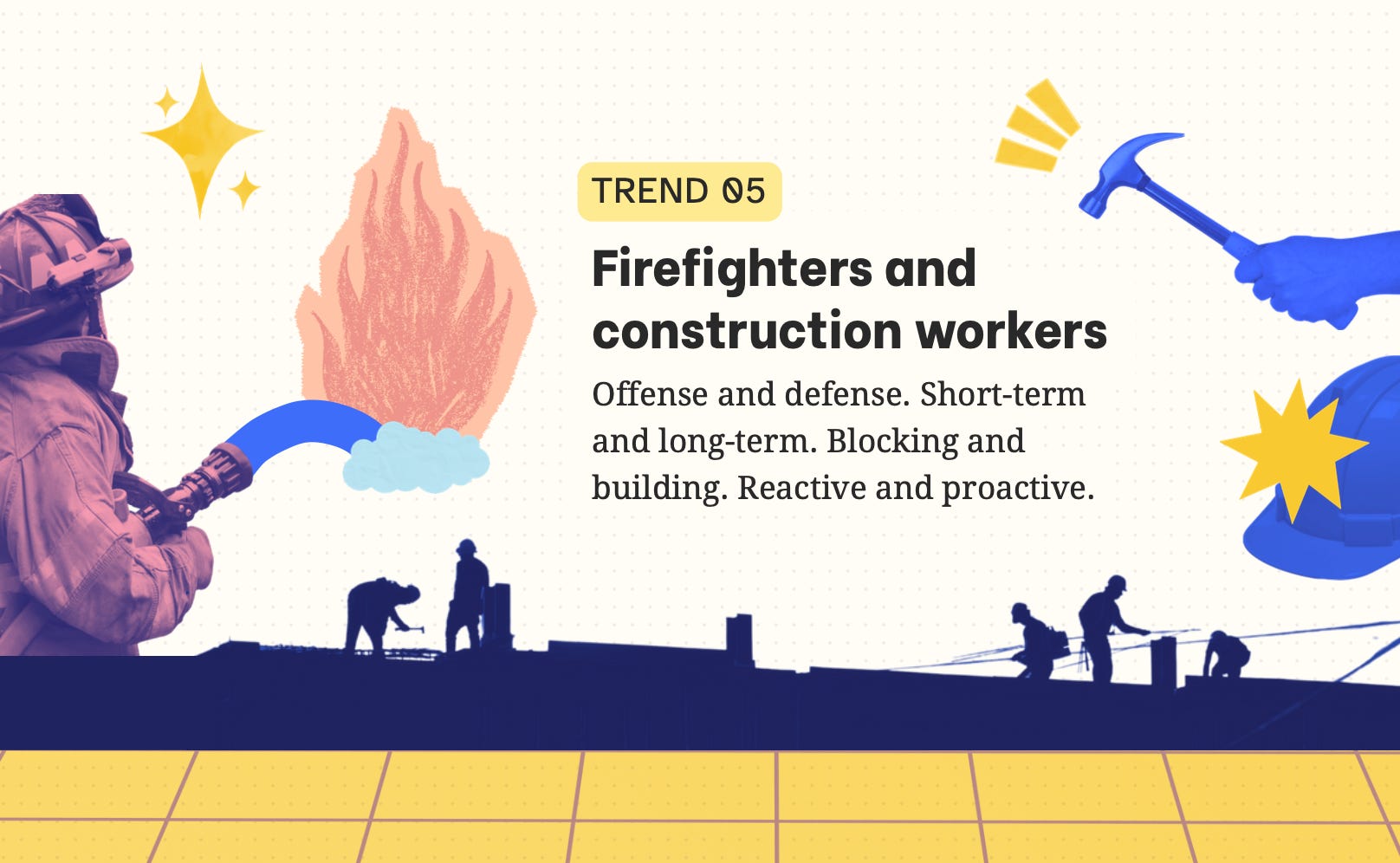
Offense and defense. Short-term and long-term. Blocking and building. Reactive and proactive. Across the democracy ecosystem, two broad functional stances have become increasingly visible: one oriented toward rapid response, the other toward long-term building.
These frames shape how organizations understand both the current moment and their own role within it. They often sit in tension with one another, and can be mutually misunderstood.
Yet both are widely seen as essential. Many interviewees said that both functions are needed, even when they tend toward one or the other, and almost all described internal tensions over how to balance them — both within themselves and their organization’s strategies.
Over the course of our interviews, we heard dozens of definitions of “democracy” and the corresponding bounds of the “democracy space” (as discussed in Differing definitions). A central question for many of our interviewees was how democracy work focused on processes related to work focused on rights. Are they part of the same ecosystem? Are they distinct? How should they interact?
We asked interviewees, “Who’s not in the democracy space, but should be?” One common answer: right-of-center actors.
In particular, interviewees questioned whether the democracy space was willing to engage beyond already-welcome individuals on the center-right. Will the democracy space reach beyond those “usual suspects” to engage today’s Republicans?
Yet some interviewees questioned whether attempting to engage the right, today’s Republicans or yesterday’s, was worth it. Some bemoaned bipartisanship for its own sake, describing it as a “false deity,” while others described chasing something — the center right — that no longer exists.
This year, frustration with these patterns sharpened, leading to a more explicit rethinking of what credible right-of-center partnership requires. Across interviews, examples of more substantive engagement emerged, pointing to possible, if uneven, shifts in how the field approaches this enduring puzzle.
Local is in, folks! As Richard Young, Founder and Executive Director of CivicLex, put it, “the democracy field in the past year started looking at working at the local level with a real sense of opportunity.”
Why the appreciation for local, place-based work in 2025? We heard three reasons from interviewees: national dysfunction, possibility at the local level, and the nudge of intermediary funders like the Trust for Civic Life and New Pluralists.
Yet interviewees also cautioned against a national turn towards local displacing the longstanding efforts of locally-rooted organizations. They also warned of localism as the silver bullet du jour for the democracy space — and missing out on the opportunity of mutual learning across national and local levels.
This year, the pluralism ecosystem felt the rest of the democracy space throwing shade their way. In a moment of authoritarian consolidation, should tackling polarization be a priority?
We often asked interviewees, “What work feels most overvalued right now?” A common response: “dialogue-only bridgebuilding.” Though the pluralism ecosystem has moved on — toward interventions using dialogue as a tool to drive action — the field’s “brand” lags behind.
Describing the democracy space as “siloed” or operating under a “scarcity mindset” can feel like reflexively singing along to a song you can’t stand. Why am I singing Katy Perry’s “Firework” in line at CVS? How do I even know these words? Why can’t I stop? Those phrases — scarcity mindset, siloed — feel ingrained in our collective psyche.
What feels new and noteworthy in 2025, however, is that there is:
A growing belief that more collaboration will help us all,
A shift away from there being a “correct” theory of change to an appreciation of different “swim lanes,” and
Meaningful progress toward building field infrastructure to facilitate coordination and collaboration.
We hope you find the full report compelling! Here’s the link!
Until next time,
Gabe
Thank you for producing the Democracy Notes 2025 Trends report. This reflection is badly needed, and the firefighter versus construction worker metaphor is excellent.
I agree the urgency is obvious. When a member of the Executive branch says, "The president believes in the United States Constitution, however…", we are in crisis. Given this moment, the report's framework is valuable. It distinguishes between organizations that maintain democratic infrastructure and those protecting rights. Both are necessary. For many communities, rights protection is existential - it determines who is safe and whose voice counts. That work must continue.
I think we should recognize a third function: democracy as the most reliable way to generate good solutions. Power lines keep the system running. Rights ensure access. Democratic practice is how communities decide what to do.
When communities face flooding, wildfire risk, or infrastructure failure, they come together around shared problems, develop working relationships, gain confidence in their ability to shape outcomes, and create solutions informed by local knowledge that outsiders would miss. This practical understanding isn't new. When Jefferson wrote that the people "may be relied on to set them to rights," he was describing communities exercising agency to respond when problems arise. Tocqueville observed Americans forming associations because cooperation was required to solve problems.
This work relies on democratic infrastructure: public meetings, negotiation across interests, accountability for community decisions. Yet it often sits outside conversations about what the democracy field is. As the report notes, the definitional questions about the field remain unresolved. As we define the field's boundaries, we should consider whether organizations practicing democracy (watershed organizations, stormwater management groups, local planning commissions, etc) belong in that frame, even when democracy isn't their stated mission.
This definitional gap may help explain why people question democracy's value. If democracy is experienced only as rights to be defended or institutions to be protected, its everyday usefulness becomes abstract.
For the democracy field, this suggests broadening our lens. Alongside protecting rights and maintaining infrastructure, we should recognize where democratic practice is building civic capacity and community trust - and learn from it. When we consider civic education we must include authentic civic experiences as central to our work.
If we lose sight of democracy as problem-solving tool, we risk another generation not understanding how self-governance improves their lives.
https://open.substack.com/pub/morfmorford/p/there-is-no-justice-without-us?utm_campaign=post-expanded-share&utm_medium=web